


報告題目:Low Inertia Systems: Complex Frequency and Simple Control
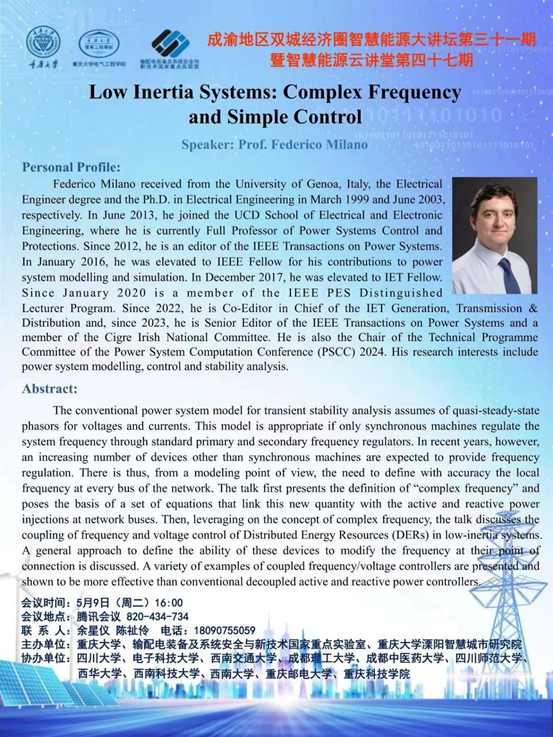
報 告 人:Prof.Federico Milano
會議時間:2023年5月9日(周二)16:00
會議地點:騰訊會議 820-434-734
主辦單位:重慶大學、輸配電裝備及系統安全與新技術國家重點實驗室、重慶大學溧陽智慧城市研究院
協辦單位:四川大學、電子科技大學、西南交通大學、成都理工大學、成都中醫藥大學、四川師范大學、西華大學、西南科技大學、西南大學、重慶郵電大學、重慶科技學院
Personal Profile:
Federico Milano received from the University of Genoa, Italy, the Electrical Engineer degree and the Ph.D. in Electrical Engineering in March 1999 and June 2003, respectively. In June 2013, he joined the UCD School of Electrical and Electronic Engineering, where he is currently Full Professor of Power Systems Control and Protections. Since 2012, he is an editor of the IEEE Transactions on Power Systems. In January 2016. he was elevated to IEEE Fellow for his contributions to power system modelling and simulation. In December 2017, he was elevated to IET Fellow. Since January 2020 is a member of the IEEE PES Distinguished Lecturer Program. Since 2022, he is Co-Editor in Chief of the IET Generation, Transmission & Distribution and, since 2023, he is Senior Editor of the IEEE Transactions on Power Systems and a member of the Cigre Irish National Committee. He is also the Chair of the Technical Programme Committee of the Power System Computation Conference (PSCC) 2024. His research interests include power system modelling, control and stability analysis.
Abstract:
The conventional power system model for transient stability analysis assumes of quasi-steady-state phasors for voltages and currents. This model is appropriate if only synchronous machines regulate the system frequency through standard primary and secondary frequency regulators. In recent years, however, an increasing number of devices other than synchronous machines are expected to provide frequency regulation. There is thus, from a modeling point of view, the need to define with accuracy the local frequency at every bus of the network. The talk first presents the definition of “complex frequency and poses the basis of a set of equations that link this new quantity with the active and reactive power injections at network buses. Then, leveraging on the concept of complex frequency, the talk discusses the coupling of frequency and voltage control of Distributed Energy Resources (DERs) in low-inertia systems. A general approach to define the ability of these devices to modify the frequency at their point of connection is discussed. A variety of examples of coupled frequency/voltage controllers are presented and shown to be more effective than conventional decoupled active and reactive power controllers.






 川公網安備 51010602000503號